Why AI Is Causing Tech Outages: PHP2Shell and Node2Shell
AI is finding vulnerabilities faster than anyone can safely fix them. PHP2Shell and Node2Shell show how end-of-life versions turn a patch into an outage.
Search "outages" right now and you get a wall of headlines. The New York Times says tech outages are only the beginning. NBC says the AI race to fix security flaws could be making outages more common. The White House's national cyber director is stepping down in the middle of it.
One contributor to these headlines is that AI is finding vulnerabilities faster than anyone can safely fix them, and the rush to patch is breaking things.
Two stories from October, PHP2Shell and Node2Shell, show a common case of this - a vulnerability comes out, teams scramble to patch the hole, but the fix is not available for the actual version of the software being run.
Are AI-found vulnerabilities causing tech outages in 2026?
Yes, in part. It happens in three steps.
AI finds the bugs. More than 100,000 CVEs have been published this year. At this point last year it was about 41,800.
Everyone scrambles to patch. Bank of America hired 1,000 contractors to fix what AI models turned up. CISA now gives federal agencies three days on the worst ones.
The scramble breaks things. Rushed patches, forced upgrades and emergency migrations are all changes to production. Changes to production are what cause outages.
Even the White House is saying it. Its explanation for this month's outages was organizations "patching vulnerabilities and upgrading outdated systems."
Here's what that looks like up close.
PHP2Shell: how an AI-found PHP vulnerability took sites offline in 2026
PHP2Shell is the cleanest example we have of an AI-found bug turning into real downtime.
Start in 2024. A PHP core developer spots a memory-handling weakness during an audit. The team can't agree on a fix, nobody has an exploit, and it sits.
Then, in August 2026, researchers at Calif point an OpenAI model at PHP's source code as part of OpenAI's Patch the Planet program. It turns that old weakness into working remote code execution. Wiz finds the same flaws independently, also with AI.
The result is two CVEs, CVE-2026-109618 and CVE-2026-109619, both rated 9.2 on CVSS 4.0. No login required. They reach back to PHP 5.4, which shipped in 2012.
The PHP2Shell fix shipped for four versions
The details leaked a day early, so the PHP project moved its release up a day, to October 21, 2026. This patch covered PHP 8.2, 8.3, 8.4 and 8.5.
PHP 7.4 through 8.1 got source patches you compile yourself. PHP 7.3 and older got nothing.
Here's why that matters. Of roughly 1.37 million internet-facing PHP hosts that report a version, 72.5% run an end-of-life branch. The fix skipped most of the install base.
CISA told end-of-life PHP users to go offline
The same day, CISA's alert said organizations still on PHP 8.1 or earlier "should take PHP-based systems offline until they can be patched or updated."
That's a big deal - A federal agency told people on unsupported versions that their options were upgrade or unplug.
A lot of them unplugged. The Dutch government took down DigiD, its national login system. Finland pulled its public government web services. French prefecture sites and German federal sites went dark too.
UptimeRobot watched its downtime alerts jump from about 3,300 a minute to about 37,000. No attacker did that. Site owners did it to themselves, on purpose, because the alternative was worse.
Then the PHP patch broke things too
Teams on supported versions had their own bad week.
PHP confirmed that 8.4.27 and 8.5.12 could crash applications that use SimpleXML. The security fix wasn't the cause. An unrelated garbage-collector change rode along in the same release.
That's the catch with taking a full upstream release in a hurry. You don't only get the fix. You get everything else that happened to be in the box.
And on November 17, the NSA's classified internal network went down. The Director of National Intelligence said patching "caused some of these systems to not come back up when you patch them as expected." CBS News reported the patches were for PHP.
Two days later, on November 19, 2026, PHP shipped another round of critical fixes. Same rule. Nothing for 8.1 and older.
Node2Shell: what happened to Node.js 20 when the fix shipped in 2026
Node2Shell landed the same day as PHP2Shell and got a fraction of the attention. It deserves more.
CVE-2026-111497 is a memory bug in the Brotli decompression library bundled inside Node.js. Two researchers at OpenAI Codex Security reported it. The affected code goes back to Brotli 1.0.3, which shipped in 2018.
On October 21, 2026, the Node.js project released fixes for the 22, 24 and 26 lines. Its advisory had one sentence for everyone else: "End-of-Life versions are always affected when a security release occurs."
Node.js 20 had gone end-of-life on April 30, 2026. Less than six months earlier.
Think about who that catches. These aren't teams running some ten-year-old runtime nobody remembers. They were on a fully supported LTS line in the spring.
"Just upgrade" on a deadline
The platforms said it plainly. Vercel told customers that Node.js 20 "will not receive this fix" and pointed them to 22 or 24. AWS Lambda had already stopped patching its Node 20 runtime.
Then the clock started. Imperva's red team reported code execution on a stock Node.js build on October 22, 2026. Other researchers reproduced it within days. The first exploit attempt in the wild showed up on October 26. CISA added it to the exploited list on October 27, with a November 10 deadline for federal agencies.
So a team on Node 20 had under three weeks to do a major-version migration it hadn't planned. New runtime. New base images. Dependency bumps. A full regression pass. All of it under a security deadline.
Node2Shell never made the evening news. Its cost was quieter. A lot of teams dropped their roadmap to rush a migration, and a rushed migration is exactly the kind of change that takes production down.
Even AWS didn't take the whole Node.js release
One detail from this story sticks with me.
When AWS patched Lambda's Node 24 runtime, it didn't move to the upstream fixed release. That release had a known regression. So AWS applied a targeted fix to the version it was already running.
AWS looked at "take the full release" and "apply only the fix" and chose the second one.
That's the right instinct. Most teams don't have AWS's engineering bench to act on it.
Why does end-of-life software turn a patch into an outage?
Because on a supported version a critical CVE is a package update, and on an end-of-life version it's a project.
Put the two stories side by side.
If you were on a supported version, your worst case was a restart and maybe a regression to chase.
If you weren't, you had three choices:
- Go offline until you can upgrade.
- Do an emergency major-version migration.
- Stay up and stay exposed.
Every one of those is a bad day. The first is an outage by definition. The second is how you cause one. The third is a breach waiting on a calendar.
That third option is the one attackers are counting on. Our CEO, Aaron Mitchell, told NPR's The Indicator this week just how much they count on it.
"About half of all exploits that happen, known exploits of a vulnerability, are happening on versions that are no longer supported by the maintainer," he said. "That number is rapidly growing."
Half. Attackers don't need a sophisticated attack. They need you to still be running the version nobody fixed.
And this is going to keep happening. AI didn't create these bugs. The PHP weakness was flagged in 2024. The Brotli code dates to 2018. What AI changed is how fast and how cheaply someone can find them and turn them into exploits.
Old code is where the bugs are. Old versions are where the fixes aren't.
How HeroDevs NES patches end-of-life PHP and Node.js without a migration
There's a fourth option, and it's the one HeroDevs builds.
HeroDevs Never-Ending Support takes the security fix and backports it to the version you already run. Not the next major. Not the latest minor with a pile of unrelated changes in it. Your version, plus the fix.
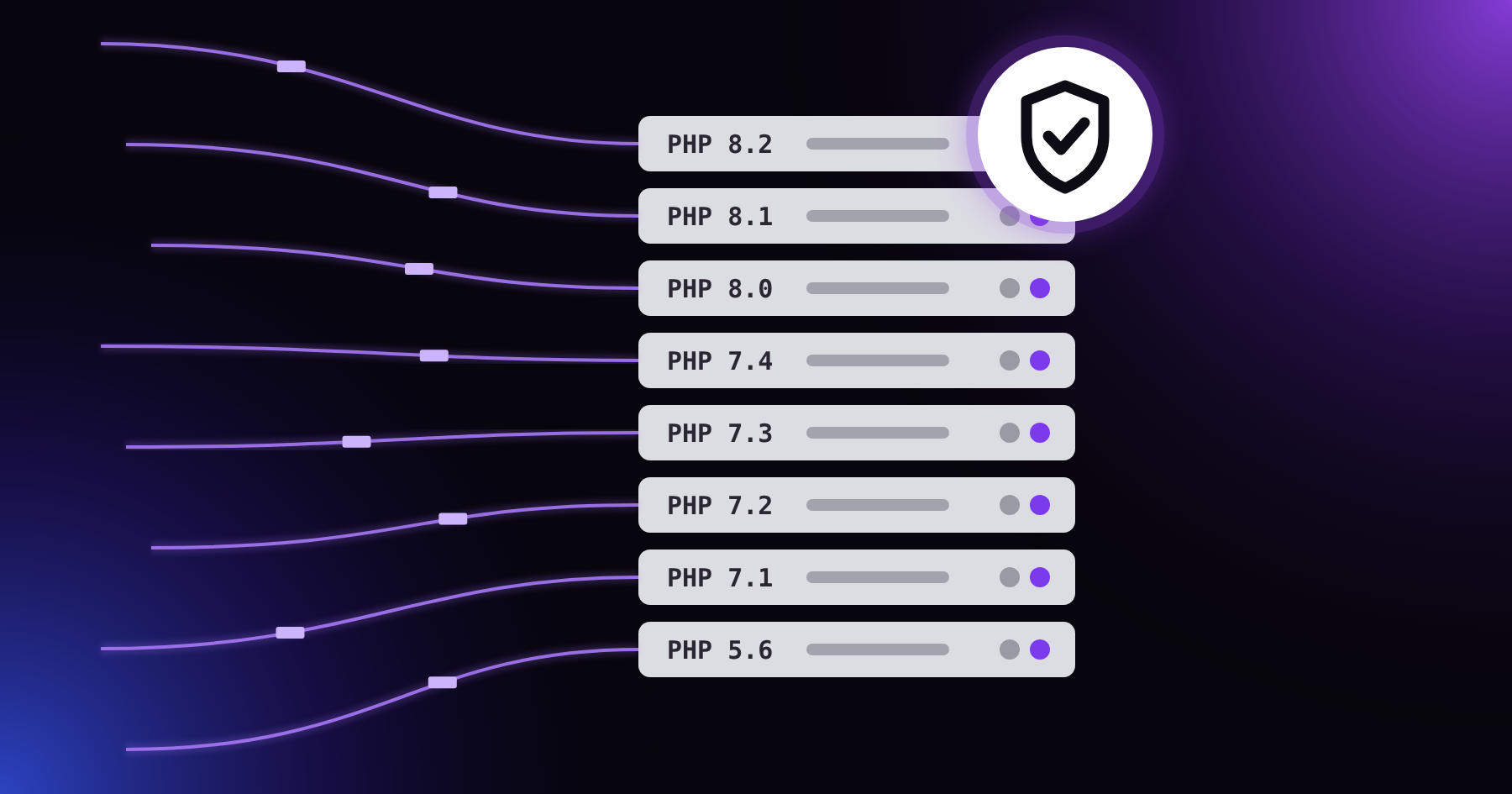
For PHP2Shell, NES for PHP has patched builds for PHP 5.6, 7.1, 7.2, 7.3, 7.4, 8.0, 8.1 and 8.2. That covers the branches the PHP project left with a source patch and the ones it left with nothing. Same PHP version, same extensions, same php.ini, same apt or dnf workflow.
For Node2Shell, NES for Node.js, built through our official partnership with the Node.js project, has fixed builds for Node.js 12, 14, 16, 18 and 20.
And when PHP shipped its second round of critical fixes on November 19, NES for PHP covered those too.
I think of it as surgical. A forced upgrade is open surgery. You came in for one problem and you're leaving with a new runtime, new dependencies and a long recovery. A backported fix is one incision.
It's still a change. You still restart your workers, and you should still test it.
But the change is tiny. The diff is the security fix. That's a very different risk than jumping from PHP 7.4 to 8.3, or Node 20 to 24, with a federal deadline three days out.
It also gives you the migration back on your own terms. You should still upgrade. You should do it on a schedule you picked, with tests you had time to write.
Taking action
If you only do three things this week:
- Find your end-of-life runtimes. Check what's serving traffic, not what the README says. PHP's CLI and web versions can differ, and Node hides in containers, Lambda functions and CI images.
# PHP: the CLI and the web server can run different versions
php -v
php-fpm -v        # or: php-cgi -v

# Node in your base images
docker run --rm <image> node -v

# Lambda functions still on Node 20
aws lambda list-functions --query "Functions[?Runtime=='nodejs20.x'].FunctionName"
- Decide your answer before the next one drops. When the next critical lands with no fix for your version, will you go offline, migrate in a panic, or apply a backport? Pick now.
- Stop treating "just upgrade" as free. It's the right long-term answer. It's a terrible incident response plan.
PHP 8.2 goes end-of-life on December 31, 2026. Node.js 22 follows on April 30, 2027. The list of versions that won't get the next fix is about to get longer.
If you're running end-of-life PHP or Node.js today, look at NES for PHP and NES for Node.js, or talk to our team.
Related reading
- PHP2Shell Is Two Critical PHP Flaws. Most of the PHP on the Internet Can't Take the Patch.
- The PHP2Shell Story & The Man Who Keeps PHP Running
- CVE-2026-111497 (Node2Shell): Node.js Brotli RCE, EOL Risk
- NES for PHP Patches the Critical Flaws in PHP's November 2026 Security Release
- PHP End-of-Life Dates: Support Timeline for Every Version (2026)
- Node.js 20 goes EOL: how to stay secure without a full migration
- NPR's The Indicator: Just how vulnerable are we to cyberattacks?


Resources
View All Articles