A customer's security review is holding up the deal
The customer's security team found unsupported components in your product and wants to know who patches them. HeroDevs patches them, and gives you the documentation to prove it.
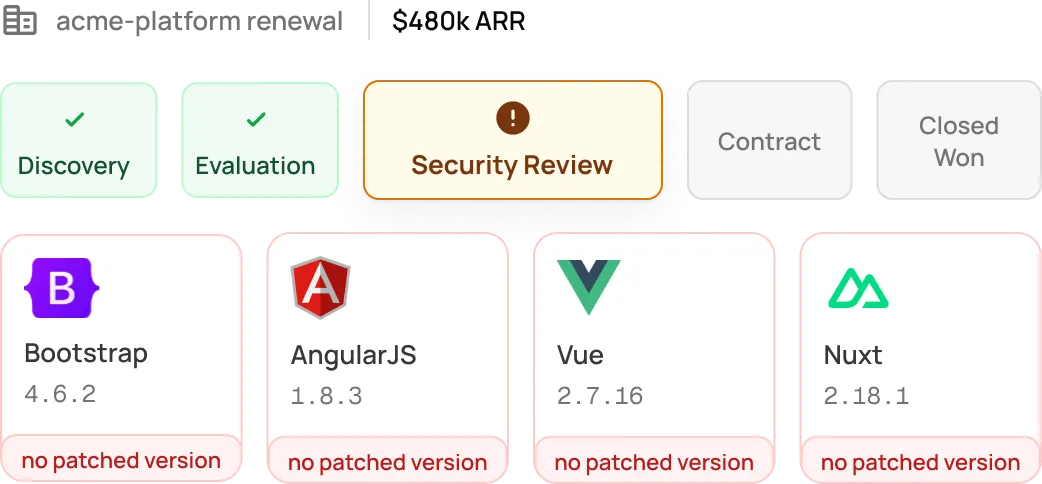
The deal stalls on something your engineering team cannot patch
The customer's security team scanned what you ship and found open source packages that reached end-of-life, meaning maintainers no longer ship security patches for them. The questionnaire asks who maintains them, when they were last updated, and what your remediation commitment is. You have no answer that satisfies any of the three.
So the deal stalls, and becomes your problem. Legal is done, procurement is ready, and the blocker is a component your team did not write and cannot patch. Sales escalates to you, because there is nobody else to escalate to, and the same conversation is waiting on every enterprise deal in the pipeline.
What breaks when upstream patches stop
Security
CVE open, no fix
Compliance
No evidence to show
Roadmap & budget
Migration inserted, spend unplanned
.webp)
See what a security review will flag
Get a report of every end-of-life dependency in what you ship, direct and transitive.

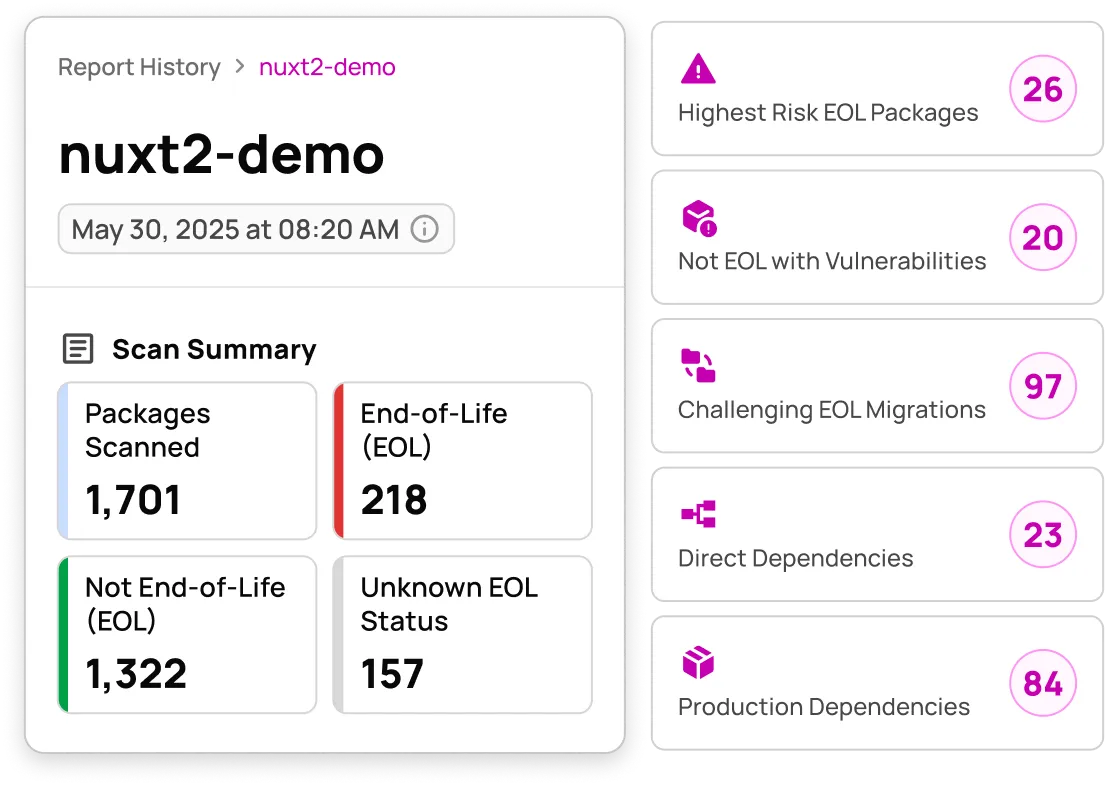
The Problem
Every potential path to clear the review carries a cost elsewhere
Migrate to a supported version
It answers the objection properly. It also means breaking changes, a full regression pass, and a new release every existing customer has to absorb, on a timeline set by one deal rather than by engineering.
Commit to remediating it later
A dated remediation plan can unblock a deal. It also creates a contractual obligation you now have to fund, on a deadline the customer set, and it will be checked at renewal.
Make AI your maintainer
That is what the question actually demands: not one patch, but a standing commitment to every future vulnerability. A reviewer cannot accept that, because a model cannot be held to anything. There is no SLA to point at, no party on the contract, and no answer when they ask who reviewed the code.
The Solution
The objection disappears because the component is supported by HeroDevs
A HeroDevs-maintained release replaces the flagged component
A secured release inside the line you already ship, so “who maintains this” has a named party behind it.
A VEX statement and a signed attestation ship with every remediation
In the format their reviewer already accepts, so there is nothing to assemble when the questionnaire arrives.
New CVEs are patched under our 14-day CVE SLA
A commitment you can put in writing, rather than a remediation date you have to fund.
Why HeroDevs?
19M+
package versions tracked
1,000+
vulnerabilities remediated
1,000+
enterprise customers secured by HeroDevs

We maintained our security posture without compromising our strategic roadmap, all while achieving substantial cost savings compared to a full migration.
Markus Wolf, Architect @ Statista
Everything the security review needs, so the deal can close
.webp)
.webp)
What security teams ask
Get answers to some of our most commonly asked questions.
Of course, if you can't find the answer you're looking for, feel free to contact us.
Something not covered here? Talk to an expert.