New features are the priority. Critical software still needs securing.
Every planning cycle makes you fund one and defer the other. HeroDevs takes the maintenance off your team, building drop-in replacements and patching them on an SLA, so that capacity goes back to the roadmap.
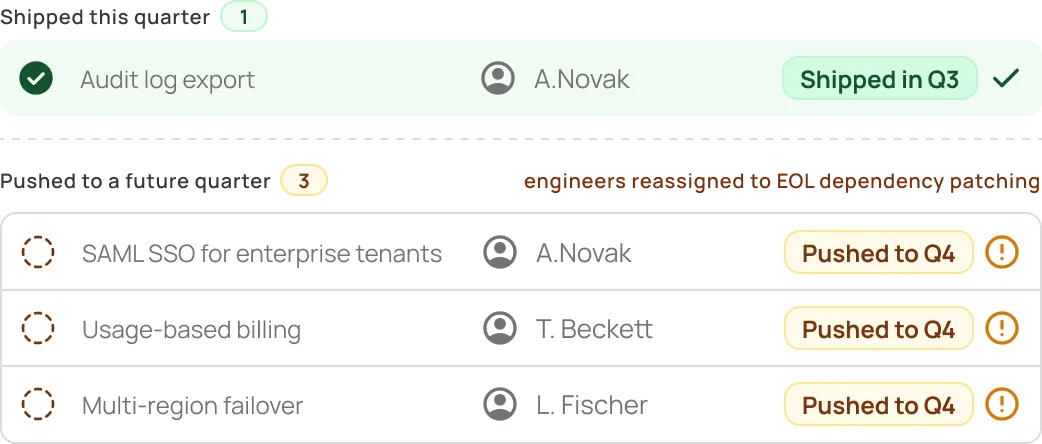
New features and secure software compete for the same engineers
You plan the quarter around what the business asked for. Then you account for keeping the open source software already earning revenue secure, and the numbers stop working. Neither priority can absorb the cut. Defer the new work and you miss what the business is expecting; defer the maintenance and you are knowingly running insecure, end-of-life open source, which no longer receives security patches from its maintainers.
Whichever way you decide, you are explaining a shortfall to someone. And you’re in the same situation again next quarter.
What breaks when upstream patches stop
Security
CVE open, no fix
Compliance
No evidence to show
Roadmap & budget
Migration inserted, spend unplanned
.webp)
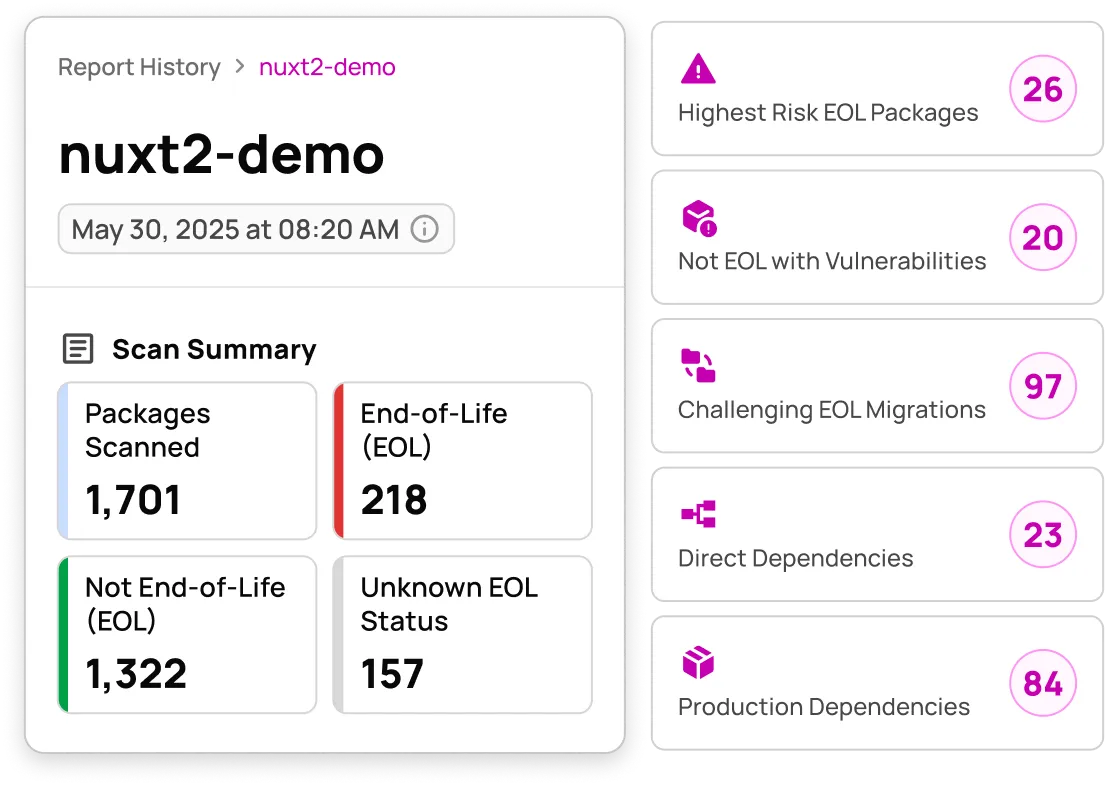
How many end-of-life dependencies are you carrying?
Get a report of every end-of-life dependency across your repositories, direct and transitive

The Problem
Three ways teams keep the software secure without stopping the roadmap
Fund it as a standing allocation
Carve out permanent capacity and you have funded a line that produces nothing new, has to be defended at every budget cycle, and grows as the dependency tree does. That headcount was the roadmap.
Defer it one more quarter
The cheapest choice this cycle and the most expensive one to be wrong about. An unpatched CVE on production software is an incident waiting for a date, and when it lands you are the person who decided to wait.
Have AI absorb it
Fast, and increasingly expected. Independent research finds that nearly half of AI-generated code introduces new vulnerabilities, and an unreviewed patch leaves an open question about who answers for it if it misses the vulnerability or breaks production.
Reference: https://www.veracode.com/blog/spring-2026-genai-code-security/
The Solution
The maintenance still happens.
It stops coming out of engineering capacity.
A supported version of the same release already exists
HeroDevs engineers build and review the drop-in replacement, inside the line you already run.
You swap it in and keep shipping
No application code changes, so the work is a dependency update rather than a project.
Support continues for as long as you run the software
Security fixes keep landing for the drop-in replacement, so the version you run stays covered for as long as your run it. Your team merges a patch instead of planning a response.
Why HeroDevs?
19M+
package versions tracked
1,000+
vulnerabilities remediated
1,000+
enterprise customers secured by HeroDevs

We maintained our security posture without compromising our strategic roadmap, all while achieving substantial cost savings compared to a full migration.
Markus Wolf, Architect @ Statista
A patched release for every CVE, without trading the roadmap for security
.webp)
What engineering teams ask
Get answers to some of our most commonly asked questions.
Of course, if you can't find the answer you're looking for, feel free to contact us.
Something not covered here? Talk to an expert.