NES for PHP Patches the Critical Flaws in PHP's November 2026 Security Release
PHP's November 2026 release fixes seven critical flaws in PHP 8.2+. NES for PHP extends those fixes to the six that also affect PHP 5.6 through 8.1.
PHP's security release of 19 November 2026 fixes 17 advisories, seven of them critical, and the PHP project's fixes cover PHP 8.2 and newer, the versions it currently supports. NES for PHP fixes the six critical flaws that also affect older versions: CVE-2026-129289, CVE-2026-115560, CVE-2026-126714, CVE-2026-129496, CVE-2026-129481, and CVE-2026-129474. The seventh, CVE-2026-129182, needs a PHP 8.5 feature that no older line has.
CVE-2026-129289 is in PHP-FPM and needs no authentication, but only where the web server keeps FastCGI connections open between requests. CVE-2026-115560 and CVE-2026-126714 are in session handling, and CVE-2026-129496 is a use-after-free in the timezone cache. CVE-2026-129481 and CVE-2026-129474 are use-after-free issues that PHP's advisories list for 8.3+ and 8.5, and the same code is present in older PHP too. CVE-2026-129474 skips PHP 5.6, which handles these calls differently.
The release also fixes the other advisories that apply to each line, including four high-severity ones. PHP 8.1 and earlier are past upstream end of life, so NES for PHP provides their fixes.
TL;DR
- PHP's security release of 19 November 2026 fixes 17 advisories, seven of them critical (CVSS 4.0 score 9.2). PHP's advisories cover PHP 8.2 and newer, its currently supported versions.
- Six of the seven critical flaws also affect older PHP. The seventh, CVE-2026-129182, needs a PHP 8.5 feature.
- PHP 8.1 and earlier are past upstream end of life, and PHP 8.2 reaches end of life on 31 December 2026.
- NES for PHP fixes the critical flaws that affect each line it maintains (PHP 5.6, 7.1–7.4 and 8.0–8.2), and 13 or 14 of the 17 advisories overall, depending on the line.
- Several flaws need a specific setup to be reached. If you cannot update today, PHP advises turning off FastCGI connection reuse (nginx fastcgi_keep_conn, Apache enablereuse) for CVE-2026-129289, and its earlier advice for CVE-2026-115560 was session.upload_progress.enabled=0. Those only block two flaws, so treat them as a stopgap.
What are the critical PHP vulnerabilities in the November 2026 release?
PHP's November release fixes seven critical vulnerabilities, each scored 9.2 on CVSS 4.0. Each one is separate and needs a different setup:
Upstream lists four of the seven for PHP 8.2, five for 8.3 and 8.4, and all seven for 8.5. PHP fixed them in 8.2.36, 8.3.37, 8.4.28 and 8.5.13.
Two of the seven build on October's critical flaw CVE-2026-109619 (PHP2Shell). The PHP security team found further scenarios after the October release and addressed them here: CVE-2026-129481 extends the earlier fix, and CVE-2026-129182 covers PHP 8.5.
Why do PHP's November 2026 flaws reach older PHP?
They reach older PHP because the PHP project's advisories cover the versions it currently supports, while the code involved goes back much further.
The code involved has a long history. FastCGI request handling, session files, timezone handling at startup, request shutdown and backtrace argument collection have been part of PHP for many releases, and older lines read, write and shut down the same way.
Version ranges describe the branches the PHP project supports, not every place the code appears. CVE-2026-129474 is listed for 8.5, but the same argument handling is present on PHP 7.1 through 8.2, and HeroDevs reproduced the issue on each line. CVE-2026-129481 is listed for 8.3 and later, and the same interrupted-shutdown path exists on older lines, where it leaves stale pointers into freed request memory. On PHP 8.0 and earlier, all modules shut down inside a single error handler, so one failure skips every later module's cleanup. PHP's advisory for CVE-2026-115560 also notes that older versions may be affected.
PHP-FPM workers also serve many requests, so memory and session issues outlive the request that triggers them. And scanners that work from the PHP project's published version ranges can report PHP 8.1 and earlier as unaffected by anything listed for 8.2 and newer.
What does NES for PHP fix?
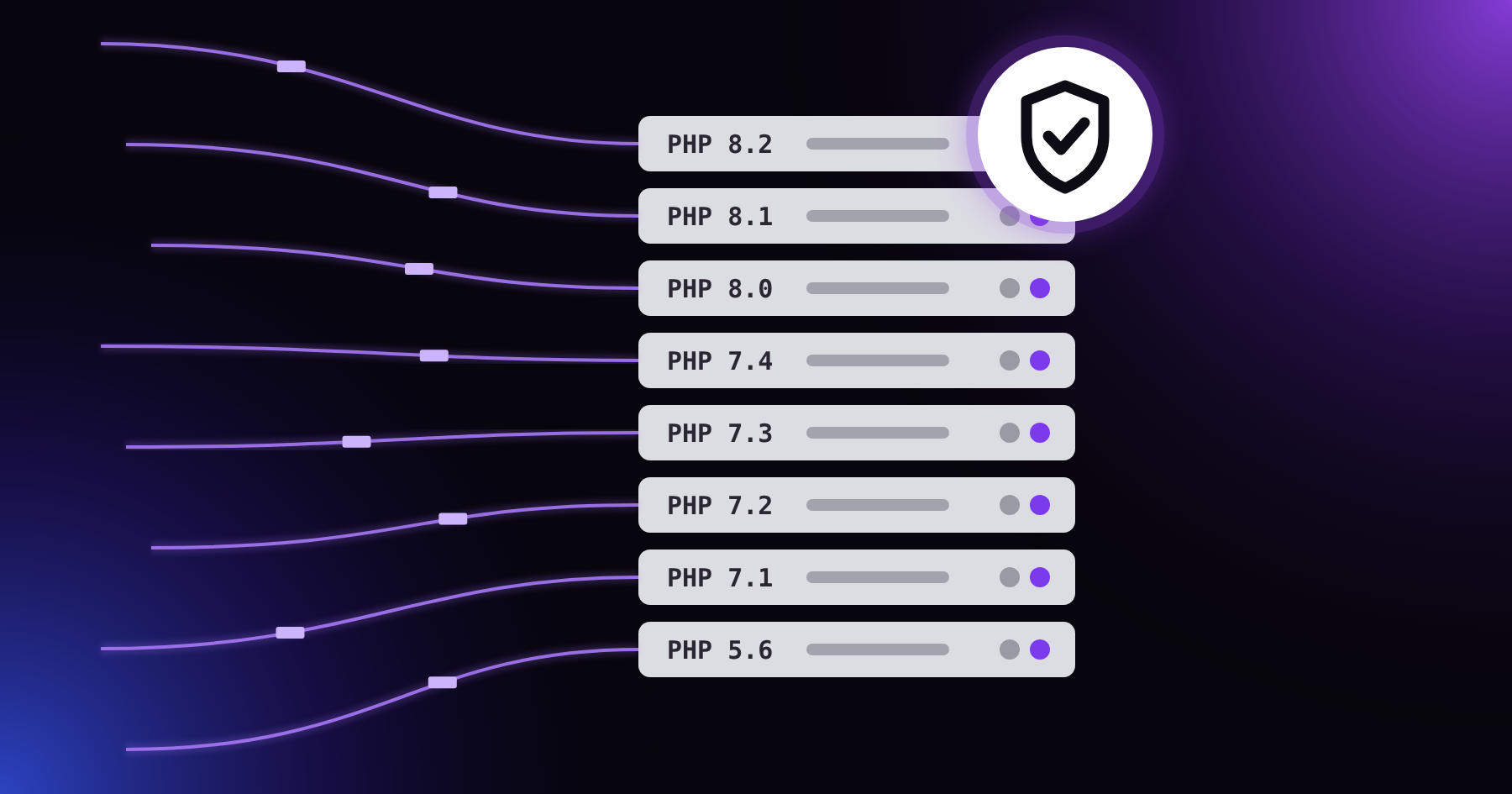
NES for PHP maintains PHP 5.6, 7.1, 7.2, 7.3, 7.4, 8.0, 8.1 and 8.2, with HeroDevs security fixes applied on top of each line's last upstream release.
NES for PHP builds on the PHP security team's fixes, which target PHP 8.2 through 8.5. HeroDevs assessed each of the 17 advisories against each older line's own source, backported the fixes that apply, and tested each one.
Every NES for PHP release lists each CVE it fixes, whether it applies to that line, and a VEX statement for each. For the critical flaws:
- CVE-2026-129289: fixed on every line. Reachable on any PHP-FPM or CGI deployment where the web server reuses FastCGI connections.
- CVE-2026-115560: fixed on every line. Where a line already shipped a mitigation, HeroDevs kept it and added upstream's fix on top, so the CVE is now reported as fixed, not mitigated.
- CVE-2026-126714: fixed on every line.
- CVE-2026-129496: fixed on every line.
- CVE-2026-129481: fixed on every line, including those below the 8.3+ range in PHP's advisory.
- CVE-2026-129474: fixed on PHP 7.1–7.4 and 8.0–8.2, which are outside the 8.5 range in PHP's advisory. Not affected on PHP 5.6, which has no equivalent call mechanism.
- CVE-2026-129182: not affected on any line. The issue is in PHP 8.5's fatal-error backtraces, and that code is not in our lines. Recorded as not affected.
The same releases also fix the other advisories that apply to each line. The high-severity ones are CVE-2026-129291 (a PHP-FPM epoll use-after-free that allows local privilege escalation to the FPM master), CVE-2026-128064 (HTTPS:// or FTPS:// URLs with an uppercase S send data in plaintext), CVE-2026-128090 (a PHAR OpenSSL signature bypass by downgrading to a keyless hash) and CVE-2026-127960 (denial of service from HTTP responses with folded headers split across many continuation lines). Two medium advisories, CVE-2026-129501 and CVE-2026-129438, need features from PHP 8.4 and 8.5 and do not affect older lines.
Full details are in the NES for PHP release notes.
How do I upgrade?
Upgrade the same way you install any NES for PHP release, following the installation instructions. Then restart PHP-FPM (or your web server, if you run PHP as an Apache module) so running workers load the fixed code.
Then check the running version. It ends in -nes:
php -v
php-fpm -v
What about PHP 8.2 and newer?
Upstream fixes PHP 8.2 through 8.5 in 8.2.36, 8.3.37, 8.4.28 and 8.5.13. If you run one of those, update to it. PHP 8.2 reaches end of life on 31 December 2026, after which it gets no upstream security fixes, so plan the move now.
Frequently asked questions
Is upstream PHP getting a fix for PHP 8.1 and earlier?
No. The PHP project's release covers PHP 8.2 through 8.5, the versions it currently supports. Older versions are where NES for PHP comes in.
Which PHP versions does NES for PHP cover?
PHP 5.6, 7.1, 7.2, 7.3, 7.4, 8.0, 8.1 and 8.2.
Do I need to change my code or configuration?
Not for most deployments. A few fixes change edge-case behavior, and the release notes list each one.
Will my scanner still flag these CVEs?
It should not. The release notes and VEX statements list the fixed CVEs as fixed and CVE-2026-129182 as not affected, which is what auditors and VEX-aware scanners need.
Does CVE-2026-129182 affect my older PHP?
No. It needs fatal-error backtraces, a PHP 8.5 feature that no older line has.
Is the fix covered by an SLA?
Yes. Fixes for CVEs in PHP source are covered by the NES for PHP SLA.
Security fixes for PHP after end of life
If you are still running PHP 5.6 through 8.1, or PHP 8.2 past 31 December 2026, NES for PHP keeps your PHP version and configuration in place, and keeps it patched. Talk to our team about coverage.
Upstream advisories: php/php-src security advisories


Resources
View All Articles