Mend.io Integration: How HeroDevs Never-Ending Support works with Mend SCA and Mend Renovate
HeroDevs Never-Ending Support (NES) integrates with Mend AppSec SCA and Mend Renovate features.
HeroDevs Never-Ending Support (NES) is integrated with Mend AppSec SCA and Mend Renovate features. HeroDevs sends Mend an automatic feed of every CVE that NES fixes, with the packages and versions covered, across npm and Maven ecosystems. When Mend SCA flags a vulnerable end-of-life (EOL) package, it can show the NES fix, and Mend Renovate opens a pull request that applies it.
The problem this solves is familiar to any engineering or security team running Mend.io. Mend SCA reports a CVE in an EOL package, and the only upstream fix sits in a newer major version that requires an impactful migration. An NES version fixes the vulnerability on the version you already run.
AI-assisted discovery is now finding flaws in EOL code faster than teams can migrate off it. An NES version closes the security and compliance gap while the migration is planned.
What Does the HeroDevs and Mend.io Integration Do?
It turns an EOL finding into a normal finding: detected, explained, and fixed in one workflow, without leaving Mend.
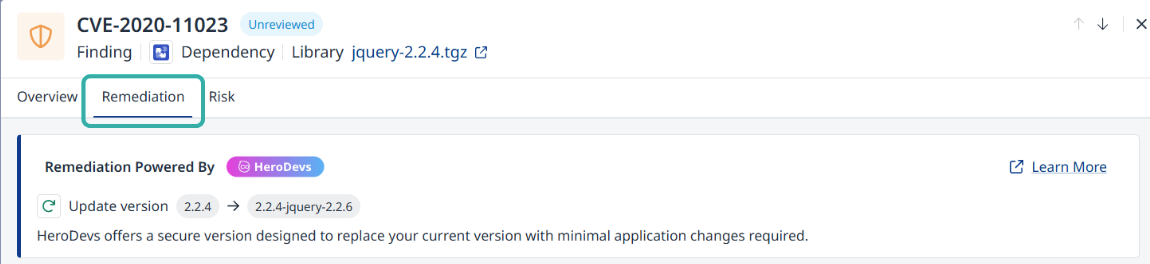
Three things make the integration useful in practice:
- The data stays current. The feed comes straight from the HeroDevs NES catalog, so new NES packages, releases, and fixed CVEs reach Mend automatically.
- Java and JavaScript are both covered. Mend.io and HeroDevs teams confirmed npm and Maven are integrated, which brings NES for Spring and the Java family into the same workflow as Angular, AngularJS, Bootstrap, Vue 2, React, and Axios among other supported frameworks and libraries.
- No rewrites. NES packages are drop-in replacements for the EOL versions you already run, so remediation requires no migration and, in most cases, no code changes.
Why Does This Matter More in 2026?
Because disclosed vulnerabilities are arriving at a record pace, and EOL packages have no upstream fix path for any of them.
Two independent sources put numbers on it:
- Google Threat Intelligence Group (GTIG), in its September 30, 2026 analysis, counted monthly vulnerability disclosures rising from 5,045 in January 2026 to 10,740 in August. Exploited vulnerabilities rose from an average of 10.5 per month in 2025 to 18 per month in 2026.
- FIRST (Forum of Incident Response and Security Teams) raised its 2026 forecast on June 15 to roughly 66,000 CVEs, citing AI-assisted discovery as a major driver.
Both reports stress that exploitation has not risen as fast as disclosure. That distinction helps teams running supported software, which can patch what matters. It does not help teams on an EOL line, where every disclosure, exploited or not, is a finding with no upstream fix
While the volume of vulnerabilities is already high, those numbers are multiplied when looking on a per version affected basis.
A supported package absorbs a new CVE with a patch release. An EOL package, and often several earlier versions of it, absorbs the same CVE as permanent, published exposure. Each time upstream fixes a vulnerability on its supported line, it documents a flaw that still exists on any older line that shares the code. One example:
- Angular. CVE-2026-88056 a server-side request forgery (NVD CVSS v3.1: 9.1 Critical; GitHub CNA CVSS v4.0: 8.6 High), was published September 10, 2026 and fixed upstream only in v20.3.30, v21.2.22 and v22.1.4. Angular 19 reached EOL on May 19, 2026, so earlier versions get nothing. HeroDevs shipped the backport on Angular 8 through 19 for NES for Angular.
AI did not create these flaws. It made them visible faster and shortened the time between disclosure and exploitation.
How the Mend-NES Workflow Runs: Detect, Decide, Merge
1. Mend SCA flags the vulnerable EOL dependency
Detection works as it does today. Mend SCA scans your repositories and container images and reports the CVE, its severity and, through Mend.io's reachability analysis, whether your code calls the vulnerable path.
2. Mend.io shows the HeroDevs NES fix
When the HeroDevs feed lists the package, version range and CVE, Mend.io can point to the NES release that resolves it. The triage question changes from "how do we fix this?" to "do we want this fix?"
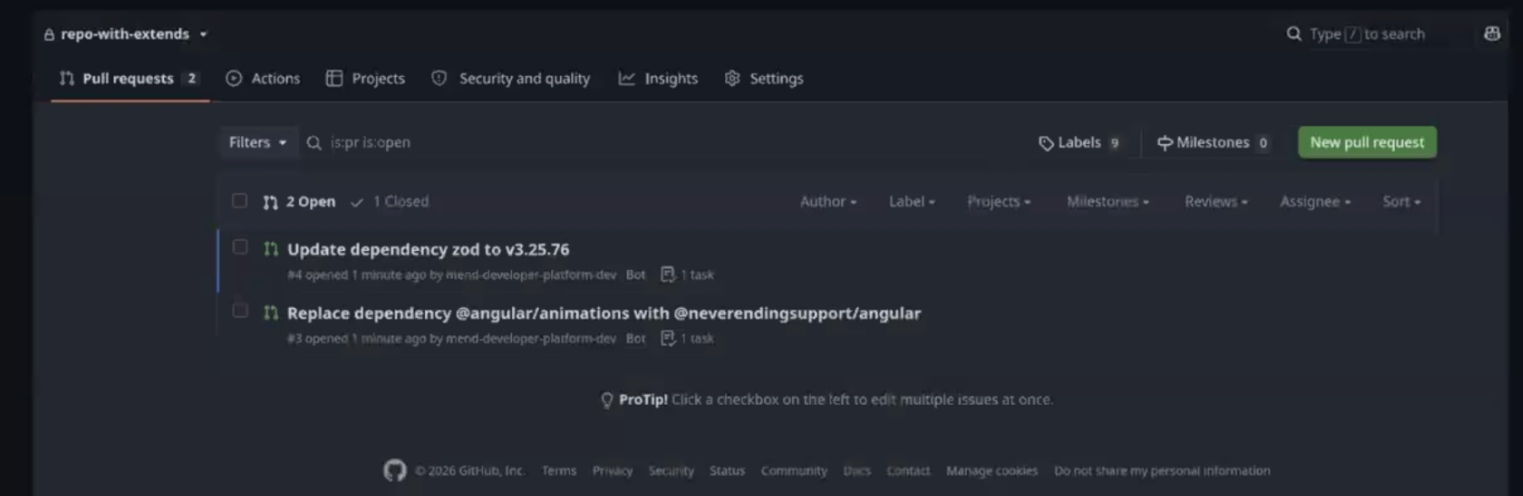
3. Mend Renovate opens the replacement pull request
For teams with an NES subscription and Mend Renovate, the remediation workflow raises a pull request that swaps the vulnerable package for its NES equivalent. The change is small:
- On npm, NES uses a package alias, so the dependency points to the HeroDevs package while your import statements stay the same.
- On Maven, NES keeps the same group and artifact IDs and uses a HeroDevs version string that names both the base release and the patched release.
That version string is why the feed matters. Without it, for example, an EOL Spring Boot artifact keeps flagging CVEs that NES already fixed. With it, those findings close.
4. Your team reviews and merges
The pull request runs through your normal CI, tests and code review. NES releases are drop-in replacements, and their release notes document any case of security-driven behavior changes, so read them before you merge, as you would for any patch.
Upgrade, Migrate, or NES: Deciding Per Finding
The integration does not make the decision for you. It puts every option in front of you at the moment you need it.
Migration remains the long-term answer for most EOL stacks. But a move such as Spring Boot 3 to 4 or Angular 19 to 22 takes real engineering time, and a CVE disclosed today does not wait for your roadmap. NES CVE fixes start when upstream support ends, and its patches support the evidence auditors ask for under NIS2 Directive, EU Cyber Resilience Act, SOC 2, CIS Controls, NIST CSF 2.0, FedRAMP, among others. See The Developer's Guide to Security Compliance for a full list.
How to Enable NES in Your Mend.io Workflow
If you run Mend AppSec Platform and see EOL npm or Maven packages this integration with HeroDevs NES helps you to secure your software supply chain. Talk to the HeroDevs team about enabling NES for the EOL packages Mend is flagging. We will map your Mend findings to NES coverage.
Frequently Asked Questions
Does Mend.io support HeroDevs Never-Ending Support?
Yes. HeroDevs sends Mend.io an automatic feed of the CVEs NES fixes, with the packages and versions covered. Mend.io uses it to show NES fixes in Mend SCA and to generate remediation pull requests through Mend Renovate.
Which ecosystems does the integration cover?
npm and Maven. That includes JavaScript NES products such as Angular, AngularJS, Vue 2, React, and Axios, and Java NES products such as Spring Framework and Spring Boot.
Do I need an NES subscription?
Yes, to install the fixes. Mend.io can show that an NES fix exists, but your build pulls it only with valid NES credentials.
Will Mend.io still flag NES packages as vulnerable?
The feed exists to prevent that. It tells Mend.io which CVEs each NES version resolves, so those findings close once the NES version is installed. For other scanners, HeroDevs publishes OpenVEX statements that document each fix.
Does Mend Renovate replace EOL packages automatically?
Mend Renovate opens a pull request; it merges only if you configure automerge. Your team reviews the NES swap like any other dependency update.
Is NES a substitute for upgrading?
No. NES is for end-of-life versions that no longer receive upstream patches, or where a migration will take longer than your risk tolerance allows.


Resources
View All Articles