NEVER-ENDING SUPPORT - OPEN SOURCE FRAMEWORK SUPPORT
Vulnerabilities are found and exploited at the speed of AI
Are you keeping up?
Most teams meet this problem the same way: a scanner flags a CVE, or an audit asks who patches a component, and your team scrambles to prioritize, patch or upgrade. Past end-of-life there is no patched version to point at -- until now.


What you get with NES
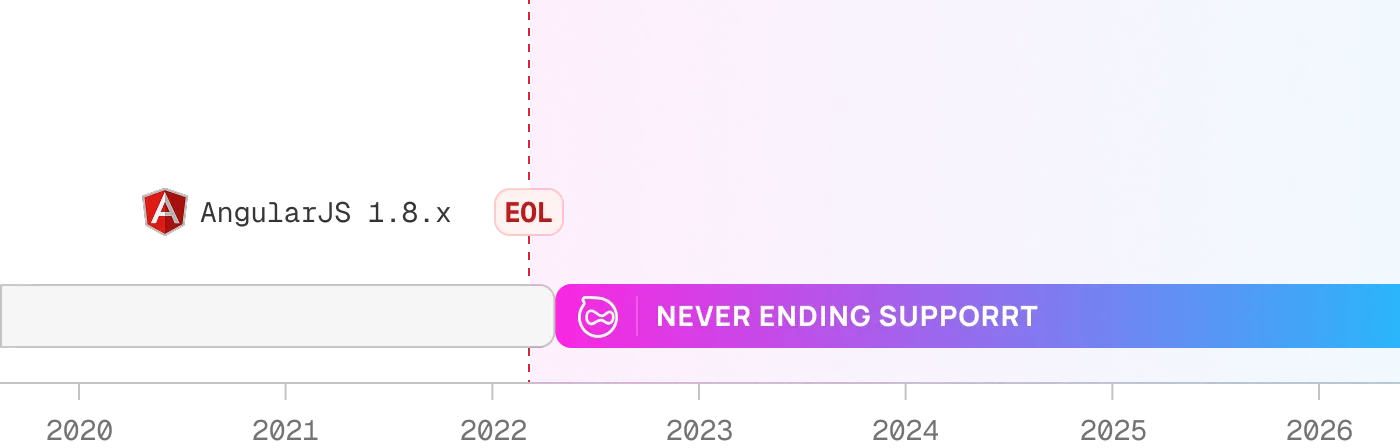
Your end-of-life framework becomes a supported one
Pick the product and version already in production: AngularJs, Spring, .NET, Angular, Vue 2, Node.js, PostgreSQL and hundreds more - and it starts receiving security patches again. Chose what you need, swap in Never Ending Support binaries, stay secure for as long as you need.
You get the fix, not a migration project
Stay secure in place, with drop-in replacements for the versions already in your application. Your team merges them and moves on.
.webp)
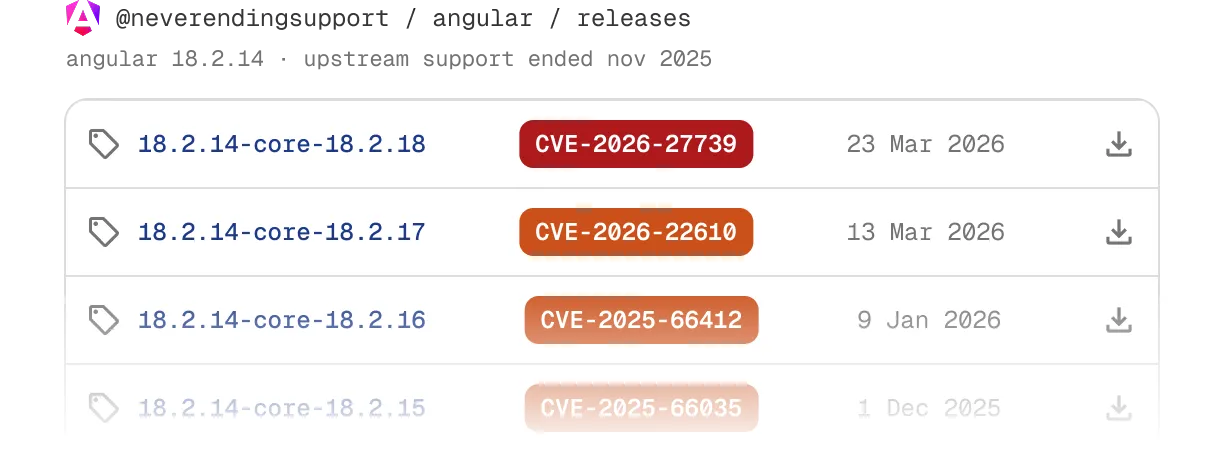
A new release every time a CVE lands
Every vulnerability in your covered versions gets found, validated, patched, and shipped as a new NES release — historically within hours of disclosure. NES internal automation is designed to keep pace with AI-driven discovery, backed by engineer maintainers who wrote the frameworks themselves.
You are always audit-ready
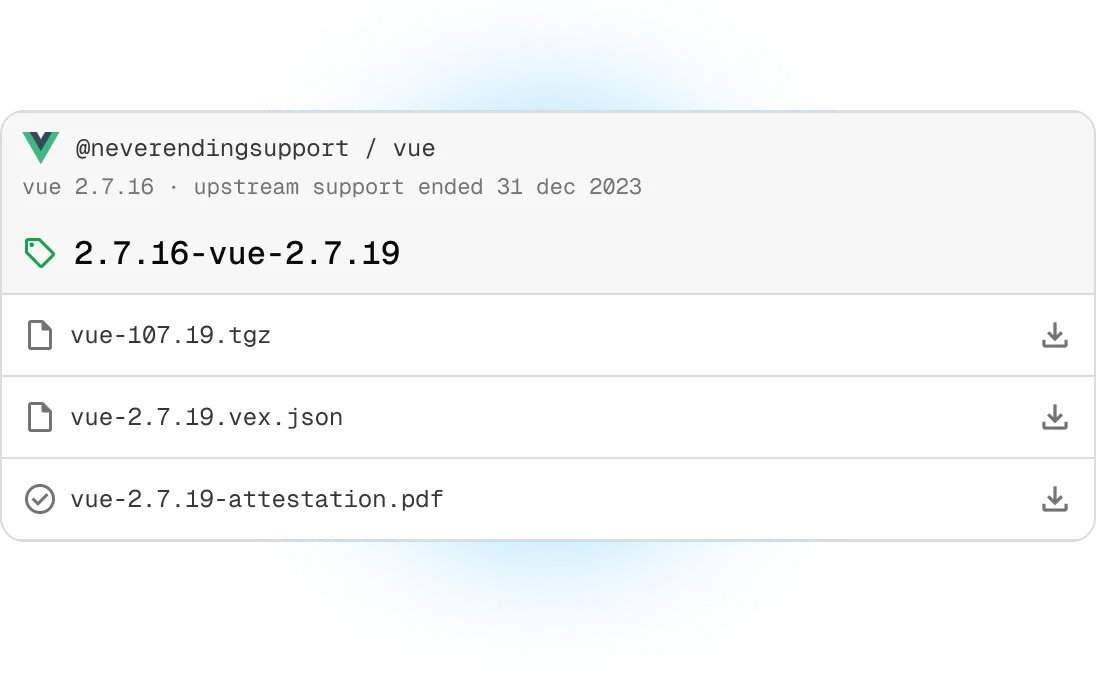
Every replacement arrives with a VEX statement and a signed attestation, mapped to the frameworks you report against. The evidence exists before an auditor asks for it.
Companies who can’t compromise on security trust HeroDevs
1,000+
customers across every major industry, from financial services and healthcare to government and technology
50%+
of the Fortune 100 rely on HeroDevs to keep end-of-life open source secure and compliant
10M+
NES package downloads, approaching ten million secured builds shipped to production












Find it. Fix it. Stay compliant.
Never-Ending Support publishes secure drop-in replacements for the end-of-life open source already running in production. The same version line, the same public API, with CVEs patched and the evidence documented.
Find it
Your SCA tool flags vulnerabilities. HeroDevs's proprietary EOL Dataset scanning over 19 million packages tells you which of those components are end-of-life, abandoned, or about to be — including your full dependency tree.
Why it matters: you cannot report on risk you cannot see, and SCA tools miss. Detection turns an unknown legacy footprint into a list of immediate remediation solutions, simply turn on NES.
Fix it
Point your package manager at the NES registry and rebuild - that simple. The replacement carries the same version line and the same public API, so there is no find-and-replace and no code change to review.Every time HeroDevs finds, validates, and fixes a CVE affecting your version, a new NES release ships.
Why it matters: a drop-in replacement is a config change your team can ship this sprint. Migrations are expensive and slow, and NES is not a substitute for eventually making one, it removes the deadline. HeroDevs engineers, including original framework authors and core contributors validate, build and test every version.
Prove it
Support commitments are written the way procurement and audit need them: SLAs for incident response and remediation, commercial contract assurances, and disclosure practices backed by HeroDevs' status as a CVE Numbering Authority. Every delivered remediation adds a VEX statement and a generated legal attestation. These documents are maintained within our public documentation.
Why it matters: an unsupported dependency is a finding. A supported one with a named vendor, an SLA, and a remediation record is a control.
Supported Technologies
36 product lines across JavaScript, Java, Python, PHP, .NET, and databases.
Coverage is priced per product, so a single end-of-life framework does not require a full-suite contract.





1,078+ CVEs remediated.
Here are the recent ones.

Apache CXF

Apache Tomcat
Apache Tomcat
Apache Tomcat
Engineers build the fix.
AI finds the work.
The replacement is the hard part, and a HeroDevs engineer builds it.
Nothing gets built until it is clear what needs replacing, so detection runs on AI at a scale no team could match.
What Engineers do
Confirm the finding is real and reachable in the versions customers actually run
Decide whether a fix can be backported without changing the public API
Write and review the patch, including original framework authors and core contributors
Sign off the release under the SLA and coordinate disclosure as a CVE Naming Authority
What AI does
Scans covered codebases continuously for vulnerability candidates, ahead of any public CVE
Correlates advisories, upstream commits, and transitive dependency graphs across 36 product lines
Assembles the reproduction case and drafts a candidate patch for review
Runs the regression suite against every supported version in the matrix
Ensuring full compliance and security
HeroDevs ensures your unsupported and unmaintained open-source software stays fully compliant with regulations like SOC 2, FedRAMP, PCI, HIPAA, DORA, and CRA. With ongoing security updates and a commitment to audit readiness, you can rest easy knowing your systems remain compliant, secure, and ready for any inspection.





Questions engineering and security teams ask
Full install notes, release histories, and the standard SLA are in the documentation.
Find out what has gone end-of-life in your stack
The next wave of CVEs will land against the components you already run. Scan your dependencies for end-of-life and unmaintained software, or talk to the team about coverage for a specific framework and version.
