Mend flags the CVEs with no upstream patch. HeroDevs supplies the fix.
The HeroDevs Never-Ending Support (NES) fix now appears next to the finding in Mend SCA. With an NES subscription, Mend Renovate opens the pull request, so your team reviews a patch on the version line it already runs instead of planning a migration.

“Knowing a vulnerability exists is half the job. Mend.io’s goal is to help customers secure their applications, and that means closing findings, not only reporting them. With HeroDevs, Mend AppSec customers using Mend SCA can now close CVEs on end-of-life open source dependencies that no longer get upstream patches.”

Asaf Saar
Chief Product Officer, Mend.io
From the Mend finding to a merged fix
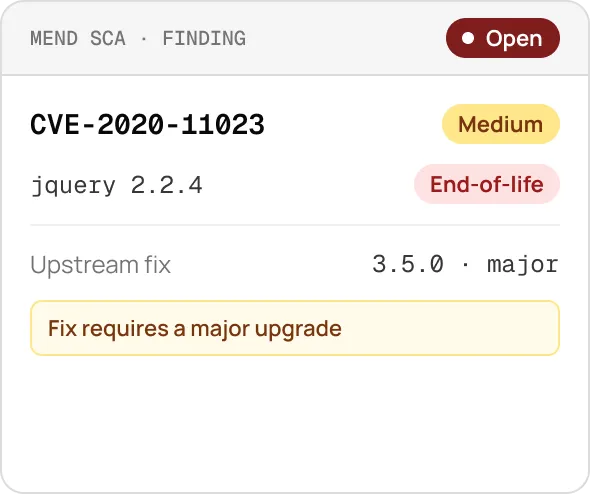
1. Mend SCA flags the CVE
Mend scans your repositories as it does today and reports the CVE on a package version that no longer receives upstream fixes.
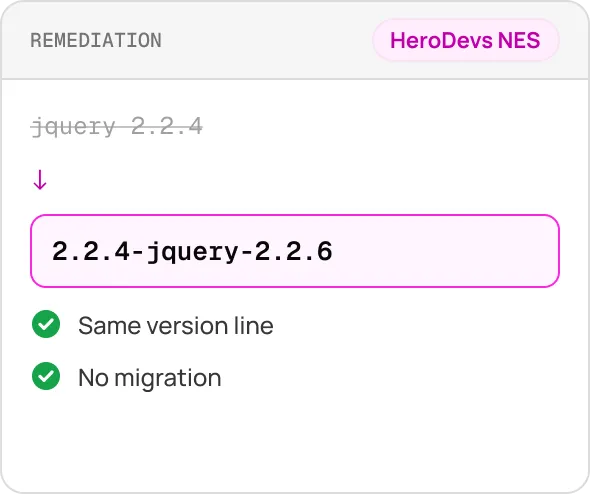
2. Mend shows the NES fix
HeroDevs continuously shares the CVEs NES fixes, by package and version, so Mend SCA can point to the NES release that fixes the CVE without a migration to a new major version.
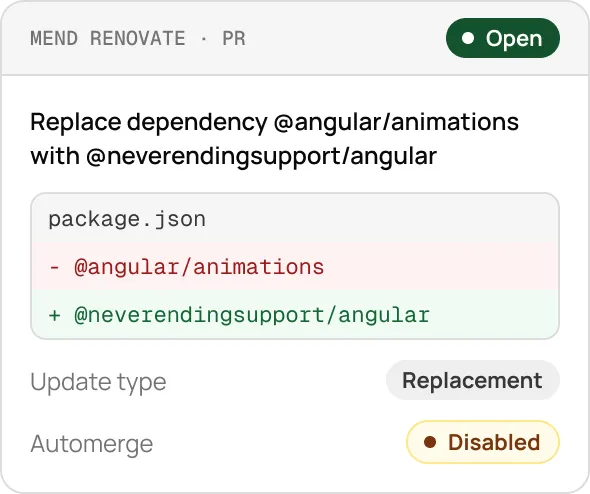
3. Mend Renovate generates the pull request
For teams with an NES subscription, Mend Renovate opens a replacement pull request that swaps the vulnerable version for its NES distribution. Your team reviews the pull request, runs your tests and merges.
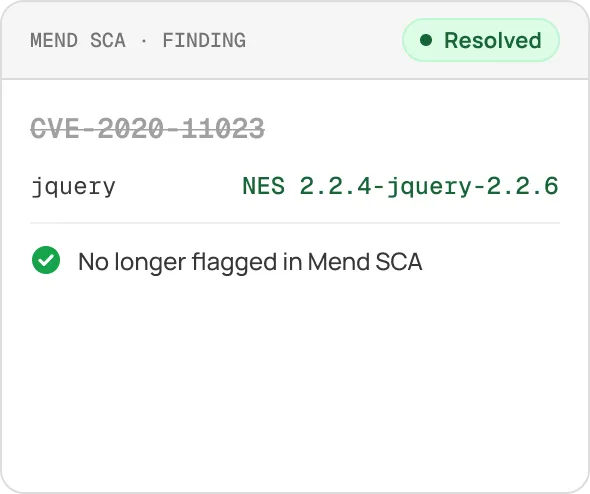
4. The finding closes
Mend recognizes which CVEs each NES version resolves, so Mend stops flagging those CVEs once the NES version is installed.
Upgrade, migrate or NES: decide per finding
A finding with no upstream patch stays open until the migration ships, and the organization carries that finding into every audit and customer security review. Mend SCA shows the HeroDevs fix alongside the other proposed fixes, so your team picks the path per finding.
An upstream fix exists on a new version of your package
Upgrade to the recommended version, manually or with Mend Renovate.
No upstream patch, and a migration is planned this quarter
Bridge with NES and stay secured and compliant until the migration ships.
No upstream patch, and a migration is months or years out
Stay on NES. NES keeps the version line patched, secure and compliant while you plan.
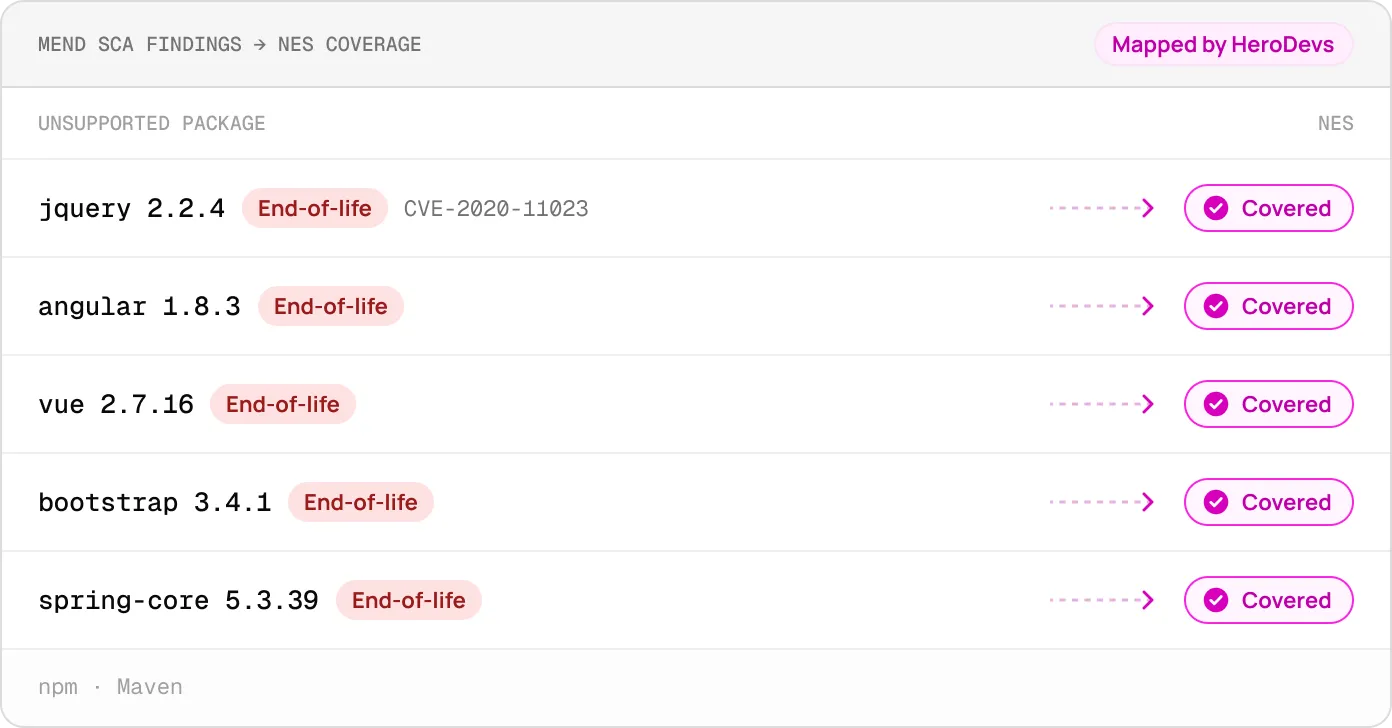
See which of your Mend findings NES covers
HeroDevs will map the CVEs Mend flags on unsupported open source in your applications to NES coverage.

HeroDevs NES and Mend FAQs
Answers to the questions we get most about the Mend integration.If you can't find what you're looking for, feel free to contact us.
See which of your Mend findings NES covers


